I scored this one from GC Used for roughly half the going used rate. The reason is because it was refinished - and it was either a terrible job or the previous owner tried to relic it. Either way, the body needs a little TLC.
Until I have the time to properly refinish it, I stuck some stickers on it - one of which may look familiar to some of you. It covers the name "Anna" that was carved into it. I think it looks better now!
Yeah, the stickers really improved the tone. ;)
I've blogged about 90's strats before - the necks are great. The bodies are typically heavier than more modern strats and don't have the same cuts/route measurements. But I think their saddles are an acoustic improvement. I understand the return to "vintage: rolled saddles, but they aren't "better". I A/B this one with my 2011 Fender American Standard strat unplugged and the 90's was certainly louder, more acoustic with more "ring" to it (if that makes any sense).
The '97 pickups are as stratty-quack sounding as any I've heard. The only confusing thing was the lack of a TBX tone pot. It has three CTS pots so my guess is the stock pots were replaced. Whoever did the replacement did it right as all pickups and switch positions function and sound as they should.
It didn't come with the trem bar but I happened to have an extra righty lying around so NBD. I actually like the (opposite) curve though I might try to straighten it out jut a bit.
The neck is in great condition as are the frets. There is some binding at the nut - the slots probably need to be widened a bit with a small dab of graphite. No case but at the price I paid I can't complain.
So there it is, the VMware strat!
Showing posts with label guitar. Show all posts
Tuesday, July 30, 2013
Sunday, December 9, 2012
Gear Review: Yakima Lynx
Overview
I had a request to post more information about this guitar that I mentioned in a previous post. First, let me re-state what I know about Yakima. They were a brand that Kramer used to sell lower-end guitars as they didn't want to diminish the Kramer brand. They were supposedly manufactured in Korea in the 1980's. Mine is a 1986/87 left-handed model. My parents bought this for me when I was a teenager and it was my first "real" guitar.
Here are a couple of full shot pics:
Headstock
It says "Lynx by Yakima" on the headstock with a paw print/graphic (with and w/o flash). The dent at the bottom is just one of things that happens when you play guitar a lot. I sure I banged it into something. Here it is with and w/o flash:
Grover tuners - very nice! I think this is a big part of the reason this thing stays in tune really well. Like I mentioned in the previous post, my friends' Squiers would go out of tune if they looked at the tremolo bar the wrong way. My Yakima stayed in tune fine unless I used the tremolo excessively but even then it held up pretty good.
Neck
Here's the neck pocket. I know it's a strat because of the small finish crack they all seem to have (hard to see in the second pic but its there)!:
The neck is a one-piece maple with bullet truss-rod and skunk stripe. The nut is 1 and 11/16th width and the fretboard has a nice 12" radius top-to-bottom:
You might have noticed I removed the nut. This is a cheap plastic piece. It has always pinched at least two of the strings so I figured now is the time to replace it with a nice black TUSQ XL. This can cause tuning and intonation issues. You know you have a nut problem when you're tuning the guitar and hear a "ping". I'm not sure I broke it when trying to get it out, or if it was already cracked in two:
Nice clean nut slot awaiting for it's replacement to arrive:
Looks like there might have been some print on the heel at one time, but its unreadable now:
Here's the neck pocket. You can see the body is hardwood laminate per the layers as seen in the sides of the pocket. We'll see these lines again when we take off the pickguard. Note that the neck pocket is nice and tight at the back (where it matters most), but not so much on the upper side:
Body - Back
Moving down to the back of the body, we see a 2-ply cavity cover. Nice since most modern imports are single-ply. Taking off the cover we see 4 springs and a nice full-sized steel trem block! You won't see this on hardly any imports that I'm aware of:
Body - Front
Moving to the front of the body, we have the standard SSS pickup configuration with 5-way switch and VTT knobs. Unfortunately, I dropped(?) the guitar on the bottom tone knob and it cracked the pickguard in that area. The good news is that there was no impact to functionality. The bridge-plate is somewhat rough, partly due to age. Nice bent steel saddles sound great - very acoustic:
A peek under the pickguard reveals dime-sized pots, nice thick wiring, little shielding and those pickups, hmmm... they don't look like standard ceramic magnets found in most cheap imports today. Someone can correct me if I'm wrong here but they look (and sound) like ALNICO magnets to me. Finally, more signs of laminate wood. Most strat enthusiasts prefer alder or ash bodies, but I don't think hardwood laminate is that bad (unlike plywood). It is very thick, dense and heavy - this thing weighs in at 8.0lbs:
Future Upgrades
I don't want to change things too much as I enjoy the guitar as it is. However, here is my short list:
Conclusion
If you see a Yakima Lynx for sale, buy it. It will probably be cheap in price, but not it fit, finish or tone. This is a very good guitar, on the same level or better than a Classic Vibe. My one complaint is the weight - too heavy for an extended gigs but no big deal for a hobbyist hack like me.
If you have any more information about Yakima brand or the Lynx line please comment. Thanks!
I had a request to post more information about this guitar that I mentioned in a previous post. First, let me re-state what I know about Yakima. They were a brand that Kramer used to sell lower-end guitars as they didn't want to diminish the Kramer brand. They were supposedly manufactured in Korea in the 1980's. Mine is a 1986/87 left-handed model. My parents bought this for me when I was a teenager and it was my first "real" guitar.
Here are a couple of full shot pics:
Headstock
It says "Lynx by Yakima" on the headstock with a paw print/graphic (with and w/o flash). The dent at the bottom is just one of things that happens when you play guitar a lot. I sure I banged it into something. Here it is with and w/o flash:
Grover tuners - very nice! I think this is a big part of the reason this thing stays in tune really well. Like I mentioned in the previous post, my friends' Squiers would go out of tune if they looked at the tremolo bar the wrong way. My Yakima stayed in tune fine unless I used the tremolo excessively but even then it held up pretty good.
Neck
Here's the neck pocket. I know it's a strat because of the small finish crack they all seem to have (hard to see in the second pic but its there)!:
The neck is a one-piece maple with bullet truss-rod and skunk stripe. The nut is 1 and 11/16th width and the fretboard has a nice 12" radius top-to-bottom:
You might have noticed I removed the nut. This is a cheap plastic piece. It has always pinched at least two of the strings so I figured now is the time to replace it with a nice black TUSQ XL. This can cause tuning and intonation issues. You know you have a nut problem when you're tuning the guitar and hear a "ping". I'm not sure I broke it when trying to get it out, or if it was already cracked in two:
Nice clean nut slot awaiting for it's replacement to arrive:
Looks like there might have been some print on the heel at one time, but its unreadable now:
Here's the neck pocket. You can see the body is hardwood laminate per the layers as seen in the sides of the pocket. We'll see these lines again when we take off the pickguard. Note that the neck pocket is nice and tight at the back (where it matters most), but not so much on the upper side:
Body - Back
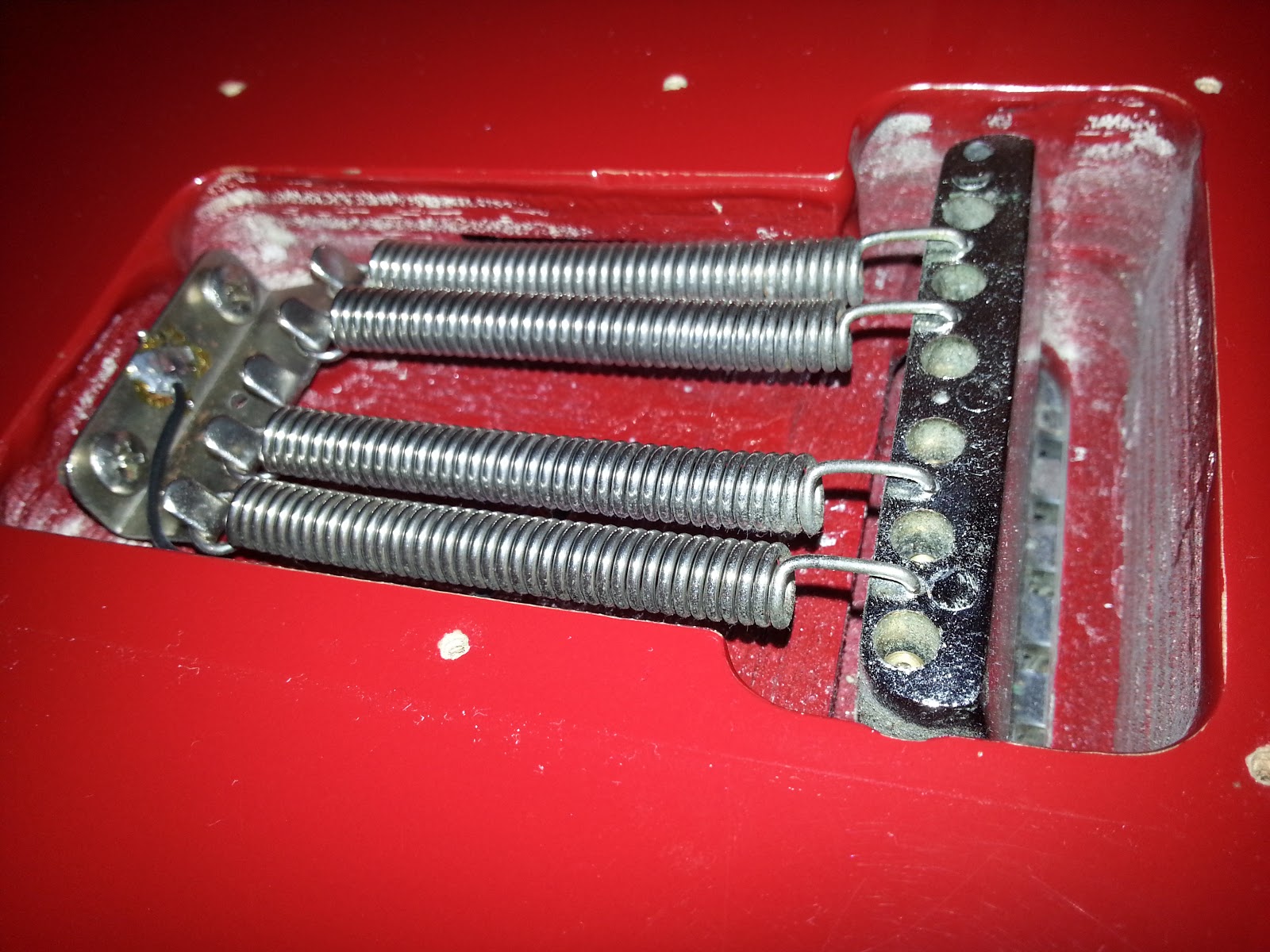
Moving down to the back of the body, we see a 2-ply cavity cover. Nice since most modern imports are single-ply. Taking off the cover we see 4 springs and a nice full-sized steel trem block! You won't see this on hardly any imports that I'm aware of:
Body - Front
Moving to the front of the body, we have the standard SSS pickup configuration with 5-way switch and VTT knobs. Unfortunately, I dropped(?) the guitar on the bottom tone knob and it cracked the pickguard in that area. The good news is that there was no impact to functionality. The bridge-plate is somewhat rough, partly due to age. Nice bent steel saddles sound great - very acoustic:
A peek under the pickguard reveals dime-sized pots, nice thick wiring, little shielding and those pickups, hmmm... they don't look like standard ceramic magnets found in most cheap imports today. Someone can correct me if I'm wrong here but they look (and sound) like ALNICO magnets to me. Finally, more signs of laminate wood. Most strat enthusiasts prefer alder or ash bodies, but I don't think hardwood laminate is that bad (unlike plywood). It is very thick, dense and heavy - this thing weighs in at 8.0lbs:
Future Upgrades
I don't want to change things too much as I enjoy the guitar as it is. However, here is my short list:
- Body cavity sheilding
- Replace pickguard
- Replace dime-sized pots with full-sized pots
- Replace cheap plastic nut with TUSQ XL (work-in-progress)
- Replace bridge-plate
Conclusion
If you see a Yakima Lynx for sale, buy it. It will probably be cheap in price, but not it fit, finish or tone. This is a very good guitar, on the same level or better than a Classic Vibe. My one complaint is the weight - too heavy for an extended gigs but no big deal for a hobbyist hack like me.
If you have any more information about Yakima brand or the Lynx line please comment. Thanks!
Monday, July 30, 2012
NGD: 199? Fender American Standard Stratocaster
Ah, oh beautiful day! I got my hands on a fantastic new (to me) instrument and my wife hasn't left me. The object of consideration for today is a 1996(?) Fender American Standard Stratocaster. I purchased this from one of my favorite used guitar outlets for almost exactly $500. Any day you can get a good strat for around $500 is a good day IMO.
Unfortunately it did not come with a case, which would have made the deal super sweet, but I'll settle for very sweet. While 90's strats aren't that rare, they are getting older. I also have not been able to find a left-handed 90's strat in this color anywhere on the Internet - so maybe this one is a little more unique? At least one can hope.
There's one thing I think is even more unique about this guitar: the model year. It seems to be somewhat of a mystery! Here's what I found so far:
The Serial Number The serial number is an "N9", which usually means 1999, except Fender mistakingly used some of these stickers on 1990 guitars.
The Date Stamps The neck has a date stamp of Feb 1, 1992 and the body has a stamp of Apr 23, 1992.
The Original Purchase Date The original owner claims he bought it new in 1996.
So it could be a 1990, 1992, 1993, 1996 or 1999 model guitar. Whew! My guess is that's its a 1993 model that didn't sell until 1996 for some reason(?).
Specs (from Fender customer service):
Model Name: American Standard Stratocaster®
Series: American Standard Series
Body: Alder (Optional Swamp Ash Body Natural Finish Only p/n# 010-7400/2-721)
Neck: Maple
Fingerboard: Maple (9.5” Radius/241 mm)
No. of Frets: 22 Medium Jumbo Frets
Scale Length: 25.5” (648 mm)
Width @ Nut: 1.6875” (43 mm)
Hardware: Chrome
Machine Heads: Fender/Schaller Deluxe Cast/Sealed
Bridge: American Standard
Pickguard: 3-Ply White
Pickups: 3 American Standard Strat Single Coils
Pickup Switching: 5-Position Blade:
Position 1. Bridge Pickup
Position 2. Bridge and Middle Pickup
Position 3. Middle Pickup
Position 4. Middle and Neck Pickup
Position 5. Neck Pickup
Controls: Master Volume, Tone (Neck), TBX Tone (Mid, Bridge),
Source: U.S.
Accessories: Molded Case
U.S. MSRP: $1,049.99 (With Swamp Ash Body $1,199.99)
INTRODUCED: 1/1986
DISCONTINUED: 6/2000
Body: Alder
I've also found that there was a temporary ban on Alder wood from sometime in 1990 till sometime in 1994. Yet, the body looks to be made of Alder. Hmmm... maybe Fender kept these guitars in the warehouse until the ban was lifted?
Neck
And the neck feels fantastic, a real pleasure to play. Not coincidentally, necks are supposed to be one of the best things about Fender strats built in the 90's. Now I can see why. This one had after-market chrome Sperzels on it - can't find those anymore. Sperzels are okay, but I prefer Schallers when it comes to locking tuners. The dial underneath the key is thicker allowing for easier (and less painful) tightening of the lock.
Electronics
It has the 90's-correct TBX tone control.
Bridge
The tremolo came with all 5 of the black springs installed. Black springs were also common for 90's era guitars. I will probably remove 2 of the springs in an effort to determine the best floating bridge setup.
Update: Oops... I did it again!
After watching used guitar sites for some time before and after this purchase, I decided I could find a better example of a 90's strat than this one. It just had too many flaws so I returned it and got my money back. It had:
I just couldn't get over the fact that for $50 more I could get a 90's strat in like-new condition. The mystique of the manufactured vs. purchased date wasn't enough to make me keep it. Oddly enough, it still played very nicely. But in the end, I decided to put the money toward a different instrument that I'll describe in a future post.
Unfortunately it did not come with a case, which would have made the deal super sweet, but I'll settle for very sweet. While 90's strats aren't that rare, they are getting older. I also have not been able to find a left-handed 90's strat in this color anywhere on the Internet - so maybe this one is a little more unique? At least one can hope.
There's one thing I think is even more unique about this guitar: the model year. It seems to be somewhat of a mystery! Here's what I found so far:
The Serial Number The serial number is an "N9", which usually means 1999, except Fender mistakingly used some of these stickers on 1990 guitars.
The Date Stamps The neck has a date stamp of Feb 1, 1992 and the body has a stamp of Apr 23, 1992.
The Original Purchase Date The original owner claims he bought it new in 1996.
So it could be a 1990, 1992, 1993, 1996 or 1999 model guitar. Whew! My guess is that's its a 1993 model that didn't sell until 1996 for some reason(?).
Specs (from Fender customer service):
Model Name: American Standard Stratocaster®
Series: American Standard Series
Body: Alder (Optional Swamp Ash Body Natural Finish Only p/n# 010-7400/2-721)
Neck: Maple
Fingerboard: Maple (9.5” Radius/241 mm)
No. of Frets: 22 Medium Jumbo Frets
Scale Length: 25.5” (648 mm)
Width @ Nut: 1.6875” (43 mm)
Hardware: Chrome
Machine Heads: Fender/Schaller Deluxe Cast/Sealed
Bridge: American Standard
Pickguard: 3-Ply White
Pickups: 3 American Standard Strat Single Coils
Pickup Switching: 5-Position Blade:
Position 1. Bridge Pickup
Position 2. Bridge and Middle Pickup
Position 3. Middle Pickup
Position 4. Middle and Neck Pickup
Position 5. Neck Pickup
Controls: Master Volume, Tone (Neck), TBX Tone (Mid, Bridge),
Source: U.S.
Accessories: Molded Case
U.S. MSRP: $1,049.99 (With Swamp Ash Body $1,199.99)
INTRODUCED: 1/1986
DISCONTINUED: 6/2000
Body: Alder
I've also found that there was a temporary ban on Alder wood from sometime in 1990 till sometime in 1994. Yet, the body looks to be made of Alder. Hmmm... maybe Fender kept these guitars in the warehouse until the ban was lifted?
Neck
And the neck feels fantastic, a real pleasure to play. Not coincidentally, necks are supposed to be one of the best things about Fender strats built in the 90's. Now I can see why. This one had after-market chrome Sperzels on it - can't find those anymore. Sperzels are okay, but I prefer Schallers when it comes to locking tuners. The dial underneath the key is thicker allowing for easier (and less painful) tightening of the lock.
Electronics
It has the 90's-correct TBX tone control.
Bridge
The tremolo came with all 5 of the black springs installed. Black springs were also common for 90's era guitars. I will probably remove 2 of the springs in an effort to determine the best floating bridge setup.
Update: Oops... I did it again!
After watching used guitar sites for some time before and after this purchase, I decided I could find a better example of a 90's strat than this one. It just had too many flaws so I returned it and got my money back. It had:
- A gash on the underside of the neck at the 2nd fret
- Finish was worn to the wood on the fretboard at the second fret
- It needed a complete fret-leveling (another $100) - which was ultimately the deal-killer for me
- Dings and dent in front and back of the headstock and down the back of the neck
- Walnut truss rod plug had some damage
- Finished was bashed-in on the bottom side of the body, like it was dropped.
- Hole in the lower horn where previous owner had flipped it backward Hendrix-style. I hate that! Righties- leave the lefties alone! It won't make you look or sound like Hendrix anyway!
I just couldn't get over the fact that for $50 more I could get a 90's strat in like-new condition. The mystique of the manufactured vs. purchased date wasn't enough to make me keep it. Oddly enough, it still played very nicely. But in the end, I decided to put the money toward a different instrument that I'll describe in a future post.
Wednesday, October 26, 2011
NGD - The StratoHog
Another Rondo deal here: http://www.rondomusic.com/sst57mhlh.html
A mahogany strat w/P90's? Why not? This is a nice heavy beast. The grain of the three-piece body is beautiful and really the main reason I bought it. It needs all of the upgrades that most SX's do: new nut, strings, saddles, block, locking tuners, pots, cap, output jack and de-goo'ing the neck.
So besides replacing the parts as mentioned above, here's the plan:
I've got 2 SD59 pickups collecting dust. I'm not a fan of noisy P90's. New pickguard + old pickups = sweet sounding strat.
I've read that the string spacing is so different on strats that the pole pieces on traditional humbuckers don't line up with the strings so you have to use "trembucker" pickups. I held up the SD to the strings and they seemed to match perfectly to my naked eye so I'm moving forward with it.
Here what it looks like now and then what it will sort of look like when I'm done (but left-handed):

I'll post pics as I make progress on the transformation. Stay tuned!
A mahogany strat w/P90's? Why not? This is a nice heavy beast. The grain of the three-piece body is beautiful and really the main reason I bought it. It needs all of the upgrades that most SX's do: new nut, strings, saddles, block, locking tuners, pots, cap, output jack and de-goo'ing the neck.
So besides replacing the parts as mentioned above, here's the plan:
I've got 2 SD59 pickups collecting dust. I'm not a fan of noisy P90's. New pickguard + old pickups = sweet sounding strat.
I've read that the string spacing is so different on strats that the pole pieces on traditional humbuckers don't line up with the strings so you have to use "trembucker" pickups. I held up the SD to the strings and they seemed to match perfectly to my naked eye so I'm moving forward with it.
Here what it looks like now and then what it will sort of look like when I'm done (but left-handed):

I'll post pics as I make progress on the transformation. Stay tuned!
Friday, July 8, 2011
The Value of Wood
If a normal person takes a step back and looks at the electric guitar industry, they must think "what a bunch of loons!" And, in fact, they would be right.
At the highest end there's the collector's segment. These are typically guitars played by rock icons such as Eric Clapton or Jimi Hendrix. They can also be "vintage" (1950s/60s), very rare models. These are uber-expensive guitars that only the rich can afford and aren't for playing, but being displayed in a museum. For example, Clapton's "Blackie" sold for almost 1 million dollars (that's m as in million)!
Then there's the "prosumer" tier - typically custom shop guitars ranging from $3000 up to $10,000 give or take. These guitars are custom creations from well-respected luthiers, either independent or working for major manufacturers such as Fender and Gibson. They are meant for playing, although many guitarist buy them and leave them locked up for fear of scratching their new, relatively expensive instrument.
Continuing down the ladder, we have the high-end "consumer" guitars. These are typically American made and weigh-in at $1000 to $2000 give or take. I believe these are typically the most sought after guitars. It's funny really, as guitarists are musicians and as such, shouldn't they be trying to be creative, unique and push musical boundaries? Yet, as a group, guitarists are about the most stubborn traditionalists I have ever seen. Bodies and headstocks must be a certain shape and have a specific name. If its not American-made it must be crap. Etc, etc. This sentiment really helps drive the sale of guitars in this segment.
Then we get to an interesting market segment, guitars in the $400 to $800 range. Mostly imports but of good to very good quality. From what I understand, more guitars are sold in this price range than any other. This make sense as Fender, Gibson and many other manufacturers sell guitars in the price range made in Mexico, Canada, Indonesia, Korea and China. Many guitarist buy this guitar as an upgrade from their beginner model (although they really want the American model but can't afford it).
Finally, there's the entry-level, cheap beginner guitars. These sell for $200 or less. They are always imported (if there are any $200 American made guitars please tell me!), usually from China. They are typically cheap pieces of junk, or are they? Find out in a future post (hint).
Does the value match the product? In my opinion, NO. Guitars have the same basic components - wood bodies, wood necks, pickups, hardware (bridge/tremolo, tuners), etc. The quality of these components vary widely. The fit and finish of the final products also vary widely.
Here's my point - the difference in value between a $200 guitar and a $3000 guitar is not $2800. The value of a $200 guitar can be doubled by spending some time setting it up and making it (more) playable. Much of the difference in value can be described as perception versus reality. As evidence, note that Gibson tried lowering the prices of their higher end guitars and found they sold fewer units which they attributed to customers' change in perception of those models(!).
American Alder is American Alder, rolled steel saddles are the same regardless if it's done by a guy in the US or some dude in China especially with today's CNC machines. Setups can vary regardless of where the guitar is made.
Are you a headstock snob? This will be a topic I'll revisit in future posts so stay tuned.
At the highest end there's the collector's segment. These are typically guitars played by rock icons such as Eric Clapton or Jimi Hendrix. They can also be "vintage" (1950s/60s), very rare models. These are uber-expensive guitars that only the rich can afford and aren't for playing, but being displayed in a museum. For example, Clapton's "Blackie" sold for almost 1 million dollars (that's m as in million)!
Then there's the "prosumer" tier - typically custom shop guitars ranging from $3000 up to $10,000 give or take. These guitars are custom creations from well-respected luthiers, either independent or working for major manufacturers such as Fender and Gibson. They are meant for playing, although many guitarist buy them and leave them locked up for fear of scratching their new, relatively expensive instrument.
Continuing down the ladder, we have the high-end "consumer" guitars. These are typically American made and weigh-in at $1000 to $2000 give or take. I believe these are typically the most sought after guitars. It's funny really, as guitarists are musicians and as such, shouldn't they be trying to be creative, unique and push musical boundaries? Yet, as a group, guitarists are about the most stubborn traditionalists I have ever seen. Bodies and headstocks must be a certain shape and have a specific name. If its not American-made it must be crap. Etc, etc. This sentiment really helps drive the sale of guitars in this segment.
Then we get to an interesting market segment, guitars in the $400 to $800 range. Mostly imports but of good to very good quality. From what I understand, more guitars are sold in this price range than any other. This make sense as Fender, Gibson and many other manufacturers sell guitars in the price range made in Mexico, Canada, Indonesia, Korea and China. Many guitarist buy this guitar as an upgrade from their beginner model (although they really want the American model but can't afford it).
Finally, there's the entry-level, cheap beginner guitars. These sell for $200 or less. They are always imported (if there are any $200 American made guitars please tell me!), usually from China. They are typically cheap pieces of junk, or are they? Find out in a future post (hint).
Does the value match the product? In my opinion, NO. Guitars have the same basic components - wood bodies, wood necks, pickups, hardware (bridge/tremolo, tuners), etc. The quality of these components vary widely. The fit and finish of the final products also vary widely.
Here's my point - the difference in value between a $200 guitar and a $3000 guitar is not $2800. The value of a $200 guitar can be doubled by spending some time setting it up and making it (more) playable. Much of the difference in value can be described as perception versus reality. As evidence, note that Gibson tried lowering the prices of their higher end guitars and found they sold fewer units which they attributed to customers' change in perception of those models(!).
American Alder is American Alder, rolled steel saddles are the same regardless if it's done by a guy in the US or some dude in China especially with today's CNC machines. Setups can vary regardless of where the guitar is made.
Are you a headstock snob? This will be a topic I'll revisit in future posts so stay tuned.
Sunday, March 6, 2011
A Tab for a Song
One of the most popular way guitarists learn how to play songs is through the use of tablature. This is an easy to understand form of music notation that shows exactly when and where each finger should go on the fretboard. Many guitar magazines include several songs tabbed-out which used to be a great way to build a library of song tabs to keep on hand for reference.
Until now...
I stumbled upon a web site named Songsterr: http://www.songsterr.com
This service like an on-line version of Guitar Pro. While not quite as robust, the basic version is free! We're talking over 60,000 tabs from over 1500 artist. That should be enough to keep me busy for awhile! Don't get me wrong, I'm not dropping any magazine subscriptions - printed tab still has a place in the guitarist's learning arsenal, but this service is awesome.
Check 'em out!
Until now...
I stumbled upon a web site named Songsterr: http://www.songsterr.com
This service like an on-line version of Guitar Pro. While not quite as robust, the basic version is free! We're talking over 60,000 tabs from over 1500 artist. That should be enough to keep me busy for awhile! Don't get me wrong, I'm not dropping any magazine subscriptions - printed tab still has a place in the guitarist's learning arsenal, but this service is awesome.
Check 'em out!
Sunday, February 27, 2011
Context: Guitars and Gear
Besides being a father and Information Technology professional, I'm also an amateur/hobbyist guitarist.. This means I'm not in a band but still practice in my living-room and occasionally write and record music. I'm trying to learn Ableton Live enough to get a tune recorded and mixed properly. I haven't decided if I'm going to do the drums using my Alesis DM6 kit or use one of the electronic drum kits in Live. Oh yeah, and I can keep a decent beat on drums. More about those efforts in a future post...
A little history... So I have been playing guitar since I was 13 years old. My first guitar was a 1940's acoustic "student model" f-hole guitar given to me by my grandma. It's amazing how well those things were made back then even though much of it was made of plywood instead of a good tone wood. Unfortunately, four years ago the top completely cracked in about five places ruining the guitar. Someday I hope to get another f-hole that hopefully in some part captures that sound. It looked a lot like this without the pickgaurd:
I forgot to mention, I'm a left-handed player. Finding lefties (or righties that I can flip upside-down and re-string) can be a challenge. Did you know less than 10% of all the people in the US (and, consequently of all guitars sold) are left-handed? Yet, there are many great left-handed guitarist. I picked up the guitar because of Jimi Hendrix (even though I didn't know he was left-handed at the time). Anyway, I digress...
A friend of mine in high school gave me his beat-up old Harmony electric guitar. It was a 70's era H802. This thing was terrible, but at least I could play chord or two on it by then. I plugged it into a cheap Magnavox stereo player. No distortion or other effects but I could hear the guitar via the microphone input and the stereo at the same time. This is when I began to play along with songs on the radio and started figuring things out. And oh the tone! (Sarcasm in case you didn't get it.)
My first "real" guitar was a "Lynx by Yakima" my parents purchased as a gift for me on my 17th birthday. I played that guitar only for many years after-wards. It's a Korean made strat copy with some decent components such as Grover tuners and a full steel block. I was told that they came out of the same factory as Kramer guitars - they wanted a low-cost line but didn't want to associate the Kramer brand with it. I remember playing guitar with friends in the late 80's and one friend of mine bought a cheap Fender Squire Bullet. He asked me why my guitar never went out of tune after using the tremolo. I don't think that Bullet ever stayed in tune regardless of tremolo usage. I didn't know it at the time but now think it has to be the tuners! The weakest thing about this guitar are the pickups. I may switch these out in a future project, stay tuned!
Fast-forward to present - I now have 7 or 8 guitars with my "spring project" guitar already lined-up. Most bring unique properties to the table. I do have three strat copies that I need to get down to one. I'm always on the look-out for good lefty deals so the list will definitely change before long. I'd like to pick up a cheap righty Explorer and flip it upside-down. What a cool body style! And I've read good things about Korina as a tone wood so picking up a 1958 Epiphone would be sweet. (Note: I'm thinking ZZ Top here, not metal.)
I'll be profiling my guitars in one way or another in a future post so keep checking back. Time to go practice!
A little history... So I have been playing guitar since I was 13 years old. My first guitar was a 1940's acoustic "student model" f-hole guitar given to me by my grandma. It's amazing how well those things were made back then even though much of it was made of plywood instead of a good tone wood. Unfortunately, four years ago the top completely cracked in about five places ruining the guitar. Someday I hope to get another f-hole that hopefully in some part captures that sound. It looked a lot like this without the pickgaurd:
I forgot to mention, I'm a left-handed player. Finding lefties (or righties that I can flip upside-down and re-string) can be a challenge. Did you know less than 10% of all the people in the US (and, consequently of all guitars sold) are left-handed? Yet, there are many great left-handed guitarist. I picked up the guitar because of Jimi Hendrix (even though I didn't know he was left-handed at the time). Anyway, I digress...
A friend of mine in high school gave me his beat-up old Harmony electric guitar. It was a 70's era H802. This thing was terrible, but at least I could play chord or two on it by then. I plugged it into a cheap Magnavox stereo player. No distortion or other effects but I could hear the guitar via the microphone input and the stereo at the same time. This is when I began to play along with songs on the radio and started figuring things out. And oh the tone! (Sarcasm in case you didn't get it.)
My first "real" guitar was a "Lynx by Yakima" my parents purchased as a gift for me on my 17th birthday. I played that guitar only for many years after-wards. It's a Korean made strat copy with some decent components such as Grover tuners and a full steel block. I was told that they came out of the same factory as Kramer guitars - they wanted a low-cost line but didn't want to associate the Kramer brand with it. I remember playing guitar with friends in the late 80's and one friend of mine bought a cheap Fender Squire Bullet. He asked me why my guitar never went out of tune after using the tremolo. I don't think that Bullet ever stayed in tune regardless of tremolo usage. I didn't know it at the time but now think it has to be the tuners! The weakest thing about this guitar are the pickups. I may switch these out in a future project, stay tuned!
Fast-forward to present - I now have 7 or 8 guitars with my "spring project" guitar already lined-up. Most bring unique properties to the table. I do have three strat copies that I need to get down to one. I'm always on the look-out for good lefty deals so the list will definitely change before long. I'd like to pick up a cheap righty Explorer and flip it upside-down. What a cool body style! And I've read good things about Korina as a tone wood so picking up a 1958 Epiphone would be sweet. (Note: I'm thinking ZZ Top here, not metal.)
I'll be profiling my guitars in one way or another in a future post so keep checking back. Time to go practice!
Subscribe to:
Posts (Atom)